
Find the answers to our most frequently asked questions. They will provide guidance.
Results
Find the answers to our most frequently asked questions. They will provide guidance.
Yes, all our courses at ETS Online that carry the Micro-Credential badge are accredited through the European Council for Theological Education (ECTE). Both the European Theological Seminary is accredited as an institution, and ETS Online (accreditation listing here).
 |
 |
Micro-credentials are short, focused higher education learning experiences that certify specific learning outcomes. Designed according to recognised standards within the European Higher Education Area, they include transparent learning outcomes, a defined workload (typically expressed in ECTS credits) and formal assessment. Find out more about micro-credential accreditation at ETS Online here.
At ETS Online, we place a high value on quality assurance. Too much false information and courses can lead to misunderstandings and unbiblical mindsets. That is why we prioritised accreditation with ECTE, a European accreditation agency specialising in theological education. Our long and fruitful relationship with ECTE reflects our continued commitment to excellence and quality.
At ETS Online, we understand how busy your schedule can be. That's why we offer complete flexibility. Study by watching, writing or reading, however suits you best.
At ETS Online, we operate under the European Credit Transfer and Accumulation System (ECTS), which assigns 25–30 hours of work to each credit. Our online courses generally require around 80–90 hours of work for 3 ECTS credits.
All our courses at ETS Online are designed so that anyone interested in studying biblical scripture, theology or counselling-related topics can join. In short, you don't need a bachelor's or master's degree. Just sign up and start learning!
No, at ETS Online our focus is on equipping you for specific challenges, tasks and ministry opportunities, or simply for spiritual growth. While you can stack various micro-credentials to create larger micro-credentials, this is not designed to offer an EQF-Level 6 (Bachelor's) or Master's degree.
You do not need to know Greek or Hebrew to take the Intro-level courses at ETS Online. If any of the intermediate or expert courses require prior knowledge of Hebrew or Greek, this will be explicitly stated in the course description.
Yes, ETS Online offers group discounts that will suit your needs. Whether you want to lead a book study on Romans with your cell group or develop your team of volunteers' hermeneutical skills to ensure sound teaching in your church, we can help. They are easily adjustable in the checkout section. The more seats, the higher the discount.
No, the price you see is the price you pay for any ETS Online course. There are no extra fees for the ETS Community or any other content within the course. Any possible reading assignments are not included in the course price and must be purchased separately. Please check the course orientation details.
Yes, as well as our ongoing group discounts, we periodically offer discounts on our courses. Make sure you follow ETS Online on social media and visit our website regularly so you don't miss out! The best option is to sign up to receive our emails — that way, you'll always be kept informed! Sign up here.
All our courses at ETS Online are conducted in English. This includes video lectures, reading assignments, quizzes, exams and other course materials.
Yes, ETS Online recommends digital libraries such as Logos and Perlego. They will not only provide great support and resources for your studies, but they will also act as your mobile library wherever you go. Read our articles about digital libraries here.
ETS Online provides quick and direct contact opportunities. You can either write to us at [email protected] or use our contact form, which you can access here.
At ETS Online, we want to work closely with leaders, ministers, missionaries and others. If you have an idea for a course that would benefit you and your ministry colleagues, we have created a space where you can submit suggestions. Click here to access the form at the bottom of this page.
If you have any problems with ETS Online, whether relating to logging in, the course, technical issues or academic matters, please contact us! We are here to help and will respond as quickly as possible! You can either use our contact form or write to us directly at [email protected].
ETS Online is the European Theological Seminary e.V.'s programme for online education, based in south-west Germany. Founded in 1949 by the Church of God (Cleveland, Tennessee) World Missions, the Seminary was established to provide biblical training and education in the post-World War II era of hopelessness and destruction. The Church of God (Cleveland, Tennessee) is the oldest Pentecostal denomination in the world. Watch our documentary here to find out more about the history of the European Theological Seminary.
No, the video lectures at ETS Online are not generated by artificial intelligence. We record our courses in two ways: 1) We record normal classroom sessions with campus students; or 2) we record the professor speaking directly to the camera in our exclusive in-house studio.
Save €200 on this one-off purchase compared to buying the courses individually.
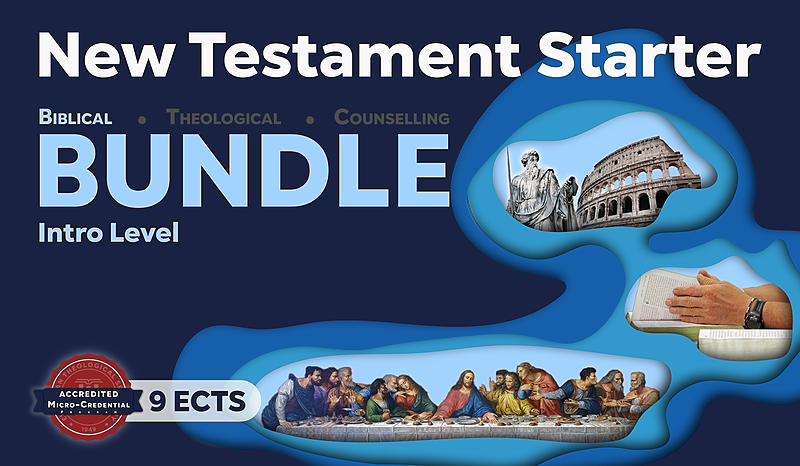
Unlock biblical insights with our course bundle: Hermeneutics, New Testament Survey, and Intro to the Book of Romans. Deepen your understanding, enhance your study skills, and explore teachings. Enroll now to elevate your theological journey.
Purchase